Beyond Borders: How Remittances Reveal the Powerful Heartbeat of Transnational Families

When we talk about global migration, the conversation often shifts into dry, macroeconomic territory—trade corridors, labor gaps, and shifting demographics. But if you look closely at the actual flow of capital, a completely different narrative emerges. It is a deeply emotional story of family solidarity, unshakeable devotion, and global communities acting as lifelines for the people they love back home.
At the center of this narrative are remittances: the hard-earned money that immigrants send across oceans and borders to support their households. Far from being simple financial transactions, these transfers represent a global web of care that keeps families bound together, no matter the distance.
The Astonishing Scale of Global Care
To truly appreciate the depth of this support, it helps to look at the sheer scale of global remittance habits. According to official statistics published by the World Bank (2024), worldwide remittance flows reached an estimated $857 billion in 2023, with flows to low- and middle-income countries (LMICs) accounting for $656 billion of that total.
To put that in perspective, these personal transfers now vastly outpace Foreign Direct Investment (FDI) and Official Development Assistance (ODA) combined for developing nations (World Bank, 2024). This means that everyday immigrant workers are doing more heavy lifting for international development and poverty alleviation than global institutions or corporate investors.
The concentration of these flows highlights where diaspora ties run deepest. Here is a look at the top global recipients of these personal lifelines:
| Country | Remittance Inflows (2023 Estimates) | Economic Impact |
|---|---|---|
| India | $120 Billion | Major driver of rural household stability |
| Mexico | $66 Billion | Outpaces many domestic industries |
| China | $50 Billion | Consistent Baseline |
| Philippines | $39 Billion | Essential foundation for health & education |
More Than Money: Remittances as “Scripts of Care”
Why do immigrants send so much home, often at great personal sacrifice? Academic research consistently shows that remittance habits are deeply rooted in a profound sense of familial obligation and altruism.
Migrants do not just send money randomly; they engage in what migration scholar Jørgen Carling (2014) calls the “scripting” of remittances. These scripts are unspoken, socially structured agreements between migrants and their left-behind relatives. The money is tightly bound to specific family milestones—paying for a niece’s university tuition, covering a grandmother’s medical emergency, or funding a sibling’s small business setup.
Furthermore, this financial support functions alongside “social remittances“—the transfer of ideas, values, and progressive norms back to home communities (World Bank, 2024). In transnational families, cash serves as a tangible proxy for physical presence. Recent studies on global care circulation have highlighted how digital tools allow migrant parents to practice “intensive mediatized parenting,” mapping out exact financial budgets side-by-side with daily video calls to maintain deep emotional bonds with their children (Solis, 2023).
For millions of transnational families, a digital wire transfer is not just currency; it is a text message that says, “I am still here, I am still working for you, and you are not forgotten.”

A Testament to Family Solidarity
Ultimately, global remittance patterns prove that the physical fragmentation of a family does not equal its emotional dissolution. Immigrant communities worldwide routinely absorb the shocks of high transfer fees—which averaged 6.4% globally in late 2023 (World Bank, 2024)—and endure grueling work hours in host countries just to ensure their loved ones live with dignity.
Remittances are the ultimate testament to human solidarity. They show us that love and responsibility are entirely capable of defying geography, transforming individual sacrifice into community resilience on a global scale.


Local Anchors in Global Networks: The Role of Globex
While global remittance data paints a picture of massive macroeconomic scale, the actual delivery of these funds relies on trusted regional hubs that interface directly with immigrant communities. In the South of France, Globex has established itself as an essential contributor to these transnational lifelines across the French Riviera. Licensed by the ACPR (Banque de France), Globex provides a secure, friction-free environment for expatriate and migrant workers looking to support their families. By operating as an official agent for premier financial corridors like Western Union and Monty Global Payments, the company effectively bridges the geographic divide—allowing individuals working along the Mediterranean coast to convert their labor into immediate, reliable aid for their households back home.
Globex Branch Locations in the South of France:
To support this continuous flow, Globex operates five strategic brick-and-mortar branches across the region:
- Antibes: 22 Avenue Robert Soleau, 06600 Antibes (Located in the town center near the train station)
- Beausoleil: 13 Boulevard de la République, 06240 Beausoleil (Adjacent to Monaco)
- Menton: 12 Avenue Boyer, 06500 Menton (Positioned seamlessly near the Italian border)
- Nice Ville: 31 Rue d’Angleterre, 06000 Nice (The network’s flagship location)
- Nice Riquier: 22 Boulevard Pierre Sola, 06300 Nice (Serving the historic Riquier district)
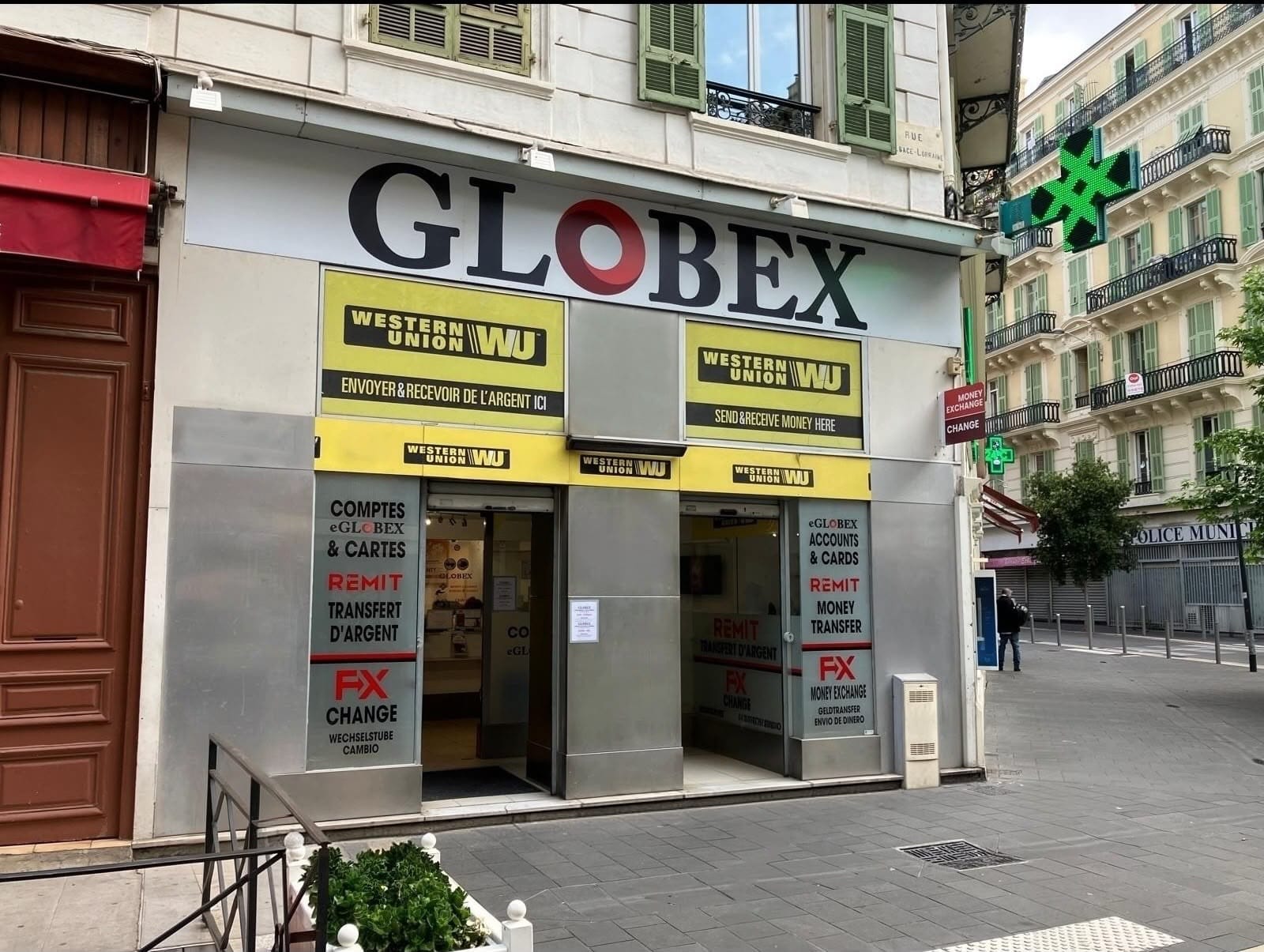
Globex in Nice Centre, France
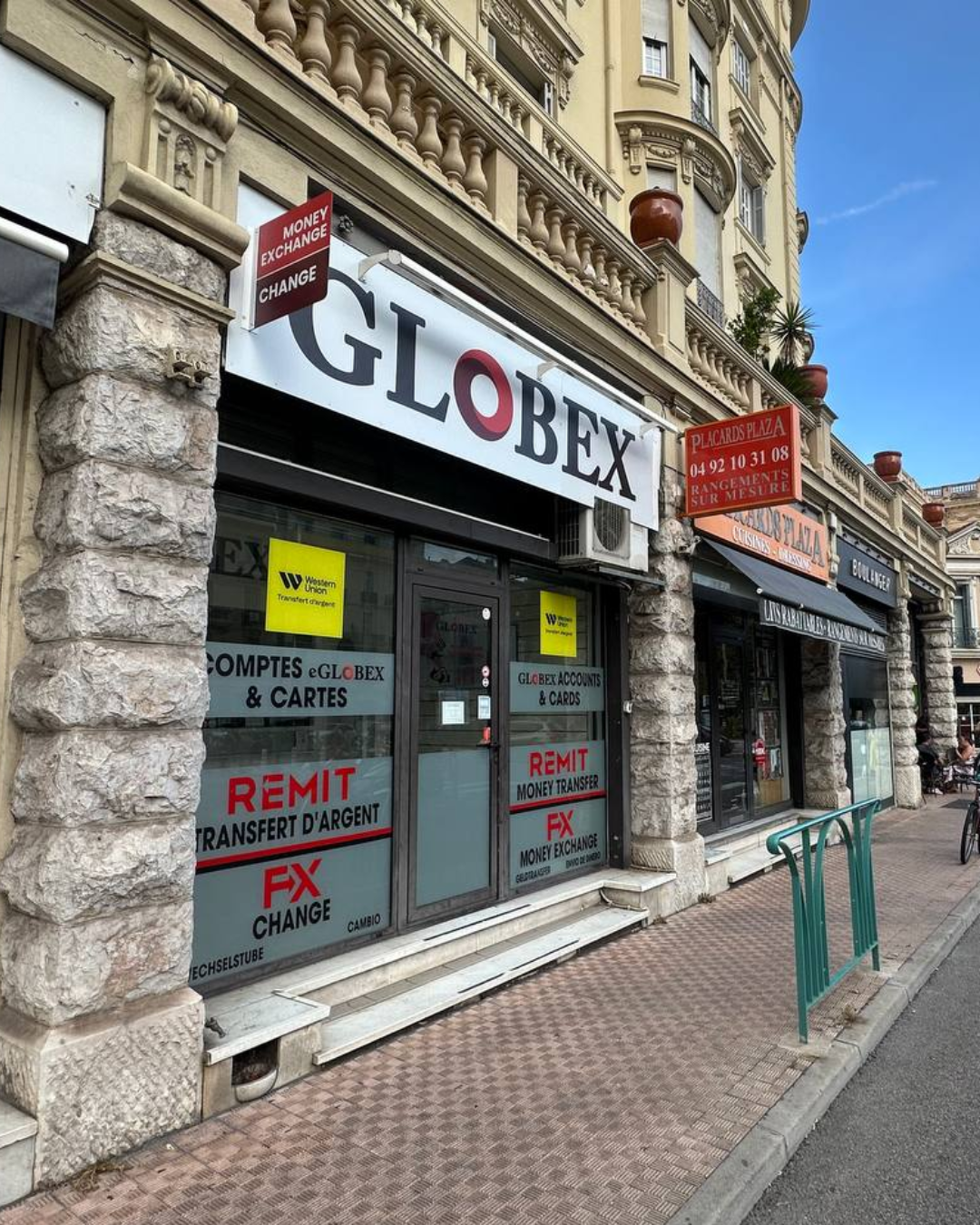
Globex in Menton, France
Your Content Goes Here
References
Carling, J. (2014). Scripting remittances: Making sense of money transfers in transnational relationships. International Migration Review, 48(Suppl. 1), 218–262.
Solis, R. J. C. (2023). Intensive care: Mediatized parenting and the circulation of transnational family care between Hong Kong and the Philippines. Plaridel. Advance online publication. doi:10.52518/2023-10rjcsls
World Bank. (2024). Remittances slowed in 2023, expected to grow faster in 2024. Washington, DC: World Bank Group. Retrieved from http://documents.worldbank.org/curated/en/099714008132436612